
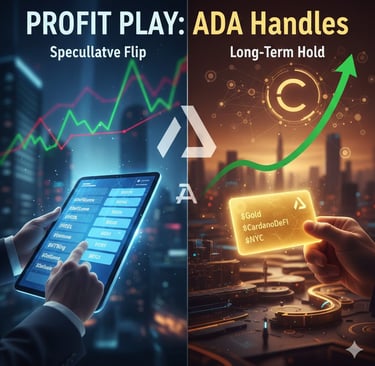
💰 Profit Play: ADA Handles a Speculative Flip or Long Term Hold
For Cardano (ADA) holders, investing in an ADA Handle NFT is more than just buying a digital collectible—it's securing a piece of decentralized identity on one of the most rigorously developed blockchains. But should you pursue a fast profit (the Speculative Flip) or hold for compounding future value (the Blue-Chip Hold)?
The strategy you choose depends entirely on the Handle's inherent rarity, its real-world relevance, and your tolerance for market risk.
1. The Handle Tier System: Rarity and Liquidity Explained
ADA Handles are categorized primarily by the length of the name, creating distinct rarity tiers that dictate both floor price and trading volume. This tiered structure is the key to understanding the market dynamics.
The Blue-Chip Hold: Gold and Silver Tier Handles
The shortest Handles—typically 3 to 5 characters in length—represent the highest tier of scarcity and utility. These are the digital equivalent of prime internet domain names or blue-chip crypto assets.
Handles in the Gold Tier (3-4 characters) are extremely scarce and hold the highest perpetual demand. They have the best brand and logo potential (e.g., $CVS, $XYZ). As the Cardano network grows, the foundational value of this absolute scarcity will only appreciate, ensuring a strong price floor. Investing in these is a long-term wealth preservation play, designed to weather market volatility and compound value over years.
Silver Tier (5 characters) Handles offer a high scarcity level, ideal for premium personal brands or short acronyms. They sit in a hybrid investment zone, suitable for either a long-term hold or a strategically timed, high-value flip if a particular name gains sudden relevance.
The Speculative Flip: Bronze and Standard Tier Handles
Handles that are moderately longer, ranging from 6 to 8 characters (often called the Bronze Tier), are where the most active trading takes place. While less scarce than the shorter tiers, they provide ample opportunity for the active trader.
The strategy here is to identify Handles that are trending, niche-specific, or tied to a newly launched project or crypto narrative (e.g., $DeFiLlama, $HODL). Volume can spike quickly if a Handle gains unexpected relevance or utility within a specific DApp, allowing for a timely speculative flip and rapid capital gains. This requires vigilant market research and precise timing. Handles of 9 or more characters (Standard Tier) are generally purchased for personal utility rather than speculative profit.
2. Brand Value and the Web3 Domain Thesis
The true long-term appreciation of a premium Handle is rooted in the Web3 Domain Thesis. This concept posits that a Handle is not just an address but the definitive digital identity for a business, DApp, or influential entity on the Cardano blockchain.
To maximize the Blue-Chip Hold potential, focus on Handles that secure necessary utility for future businesses. This includes names related to:
Corporate & DApp Identity: Generic, high-value names that future decentralized exchanges, wallets, or major corporate participants will require (e.g., $Starbucks, $SundaeSwap).
Real-World Assets (RWA): Handles tied to physical assets or highly tradeable commodities (e.g., $Gold, $Bonds). As Cardano expands into institutional adoption and tokenization, these names will become foundational infrastructure.
Geo-Specific Names: Short names representing major cities or regions (e.g., $Tokyo, $NYC) that will be essential for localized Cardano hubs or financial institutions.
By securing these types of Handles, investors are effectively holding an early piece of the naming infrastructure for the entire future Cardano ecosystem.
3. Exit Liquidity: Why Handles Beat General NFTs
A common concern with collectible NFTs is illiquidity—the difficulty of finding a buyer. ADA Handles fundamentally mitigate this risk due to their perpetual utility.
Guaranteed Demand Floor: Every Handle, regardless of its name, has the built-in utility of replacing a long, complex Cardano wallet key (e.g., addr1q...) with a simple, human-readable name (e.g., $MyWallet). As long as ADA is transacted, Handles will have a utility-driven demand, establishing a natural demand floor far above purely speculative collectibles.
DDNS Functionality: Handles act as a Decentralized Domain Name Service (DDNS) for the Cardano blockchain. Since they are a core piece of network infrastructure, they maintain a greater degree of stability and long-term demand than pure consumer collectibles.
In short, the standardization and utility inherent in ADA Handles provide clearer price discovery for both speculators and long-term holders, offering a more liquid and predictable market than many other NFT classes. Courtesy https://AdaWalletName.com
Help
Questions? Reach out anytime
Contact
© 2026. All rights reserved.
None of the content, comments, articles or recommendations are to be considered financial advice in any way shape or form.